


Ecologist Michael Peers checks the survival of radio-collared snowshoe hares using VHF telemetry in southwestern Yukon. Photo by Y. Majchrzak
Warmer winters with less snowfall could wreak havoc on snowshoe hare populations in the Canadian North – and the fallout has consequences for other wildlife such as lynx and coyotes, according to a new study by University of Alberta ecologists.
“Our study shows that snowshoe hare survival is significantly reduced in shallow snow, particularly when snow depths are less than 35 cm,” said Michael Peers, who led the research during his PhD studies in the Faculty of Science.
“This is likely due to improved hunting success of their predators, especially coyotes, which almost exclusively killed hares in shallow snow. Projections developed from our data indicate that future winters with prolonged shallow snow could cause hare populations to decline.”
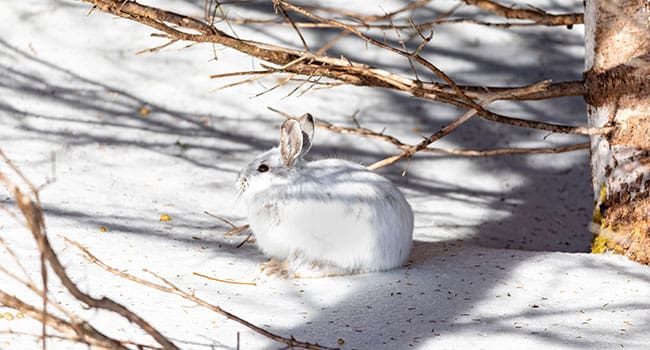
The snowshoe hare’s survival is significantly reduced in shallow snow, particularly when snow depths are less than 35 cm. Photo by Thomas Lipke
Adapted for the snow with large feet, snowshoe hares are most successful in deep and even soft snow. But results from the study show that in the last 20 years, winter snow depths have declined by about 35 per cent in the Yukon – a bad sign for the snow-dwelling hares.
Further, the decline of snowshoe hare populations in the Canadian North could create a negative ripple effect for other species in the boreal forest as an ecosystem, Peers noted.
“Climate change is affecting species around the globe,” he said. “Numerous species in the North that are well adapted to cold, deep-snow environments will likely be negatively affected by changes in climate that we are observing. These projections of declining hare populations are concerning, as they could indeed become reality.”
Peers completed the research under the supervision of Prof. Stan Boutin in the Department of Biological Sciences.
| By Katie Willis
Folio, a Troy Media content provider partner, is the University of Alberta’s online publication.

The views, opinions and positions expressed by columnists and contributors are the author’s alone. They do not inherently or expressly reflect the views, opinions and/or positions of our publication.



0 Comments